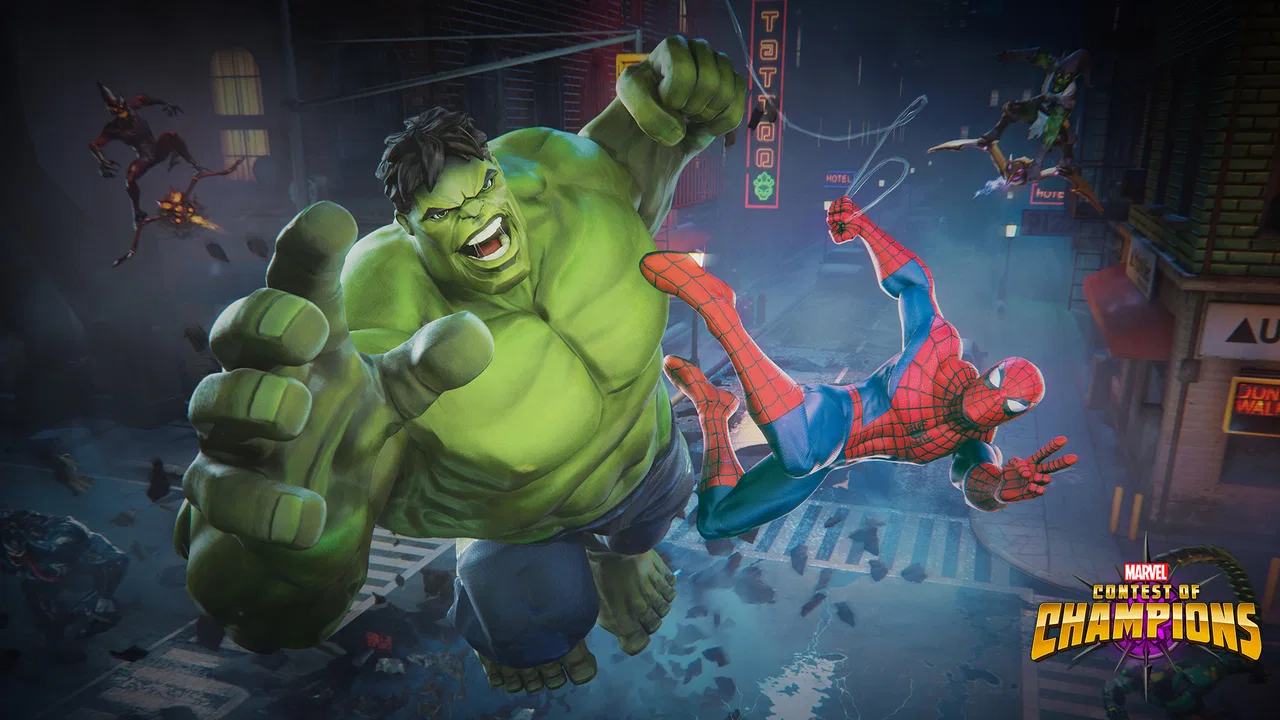
Marvel Contest of Champions
- 4.2
- Rating
- 100.00M
- Installs
- Free
- Price

 Analysis by App-foxy
I spent time with Marvel Contest of Champions as the kind of player who wants more than a quick superhero distraction. It is a mobile action fighting game from Kabam Games, Inc., built around short battles, a large Marvel roster, and a steady cycle of collecting, upgrading, and testing champions. The basic appeal is immediate: choose a fighter, learn a few attacks, and try to outplay an opponent rather than simply tapping through an automatic encounter.
That simplicity is also slightly misleading. The opening fights are easy to understand, but the game gradually asks you to recognize attack ranges, block safely, evade at the right moment, manage special attacks, and build a team that suits the path ahead. I found the most satisfying progress came when I stopped treating every fight as a damage race. Timing, matchup knowledge, and patience often mattered more than bringing the strongest-looking champion.
The game is free to download and has a Teen content rating. It has been available since December 10, 2014, and its current version is 55.0.0, with support beginning at Android 8.0. On the store, it has a 4.1 average from around 3.2 million ratings, with over 100 million installs. Those figures explain why it is easy to find an active community, but they do not tell you whether its long-term style suits you. My experience is that this is best approached as a persistent hobby, not as a small offline-style fighting game.
You May Also Like

 Blood Strike: 2.5 Anniversary
Blood Strike’s Loadouts Turn Every Drop Into a Tactical Gamble
A close look at Blood Strike’s custom loadouts: how fast access to signature weapons reshapes its battle royale rhythm, rewards preparation, and narrows the gap between fights.

 Pandora - Music & Podcasts
Pandora’s Music Is Easy to Start, but Harder to Recover
Pandora’s strength is its low-effort path from a seed to a station. Its weak spot is how much confidence it asks you to place in connection, setup, and quiet recovery.

 8 Ball Pool
 Is Built on Rivalries, Rematches, and Routine
A close look at the rivalries, rematches, shared routines, and unanswered safety questions that turn a quick pool match into a persistent mobile community.

 Samsung Music
’s Quiet Strength Is Playing What You Already Own
Its reach comes less from spectacle than from dependable access to a personal library. That simplicity is both the app’s strongest retention engine and its ceiling.

 AccuWeather: Weather Radar
AccuWeather Review: A Quick, Clear Forecast for Everyday Decisions
For everyday plans, the best forecast is the one you can understand quickly. AccuWeather makes rain timing, radar, and local conditions easy to act on, with a few trade-offs.

 Hill Climb Racing
Why Hill Climb Racing Still Turns Crashes Into One More Run
A tiny car, a bumpy hill and one more upgrade: Hill Climb Racing keeps resurfacing because its simple chaos makes every near-miss feel personal.
More From Our News Desk



How a normal play session actually works
I use this section to set out a practical rhythm for a session, from choosing a goal to deciding when to stop, so the game’s mix of fighting and progression feels manageable. I’ll also explain why a little preparation can make short bursts more rewarding, before looking at how those habits develop over time.
Start with the fight, not the collection screen
The most reliable baseline workflow is simple: check the available content, choose a small group of champions, and enter battles with a clear purpose. Sometimes that purpose is progressing through a quest. Sometimes it is practicing a difficult matchup, completing an objective, or using energy efficiently. I recommend resisting the urge to upgrade every character as soon as resources appear. A broad roster is useful, but scattered investment can leave you with many average options and no dependable core team.
In a normal fight, I begin by watching the opponent for a few seconds instead of immediately attacking. A light opening can work, but it is often safer to learn whether the opponent advances aggressively, blocks frequently, or leaves room after a missed strike. A short attack string followed by a retreat is more useful than repeatedly holding the opponent against the edge without knowing how they respond.
The controls are designed for touchscreens, so movement and defense are closely tied to finger rhythm. Swiping toward the opponent attacks, swiping away creates distance, and holding generally supports blocking. The important habit is to separate those actions mentally. New players often swipe constantly and accidentally turn a defensive moment into an attack. I improved faster when I treated each exchange as a small sequence: approach, test, defend, punish, then reset.
Why short sessions can still be productive
A realistic everyday use case is a ten-minute commute or a break between tasks. I can complete a few fights, claim available rewards, or practice one champion without needing to settle in for a long uninterrupted session. That makes the game more convenient than many traditional fighting games, especially when I want a focused burst of action rather than a full console-style match.
There is a catch: the wider progression loop can encourage longer check-ins. Energy, objectives, upgrade materials, and rotating activities create reasons to return, but not every return feels equally rewarding. If I open the game without a plan, I can spend more time sorting champions and rewards than actually fighting. My practical advice is to decide before launching whether you are progressing, farming a resource, or practicing. That small distinction keeps the session from becoming menu-heavy.
Build a dependable starting team
Early on, I would rather have a small group of champions I understand than constantly switch to unfamiliar characters. A dependable team should cover different situations, but it also needs to feel comfortable under pressure. One champion may be easy to control defensively, another may deliver strong burst damage, and a third may be useful because of a particular ability interaction. The best choice is not always the champion with the highest visible rating.
When I test a new character, I pay attention to three things: how easily I can reach a special attack, how safe the basic combo feels, and whether the champion remains useful when the opponent blocks. This tells me more than a quick look at the roster screen. It also prevents a common mistake: spending resources on a character who looks impressive but does not match my timing or preferred range.
Settings that deserve a quick check
I recommend looking through the settings before settling into serious play. The exact options available can vary by platform and version, so I focus on the practical principle rather than pretending every device presents the same menu. Make sure touch controls feel predictable, audio is comfortable for your surroundings, and notifications are not interrupting a fight or pulling you back into the game when you would rather not play.
Sound is more useful than it first appears. Distinct attack and special-move effects can help me notice what is happening when visual effects become busy. I do not rely on audio alone, but lowering music while keeping important effects audible can make practice sessions easier to read. Conversely, if I am playing in public, turning down effects prevents the game from becoming distracting without changing the core control experience.
Battery and heat are also worth considering. Longer fights, menus, and repeated loading can make a phone feel warmer than a short arcade game would. I prefer playing while the device is not already under heavy load, especially when I am attempting difficult content. This is not a reason to avoid the game, but it is a practical limitation for older or less powerful phones, even when the operating system meets the minimum requirement.
Use repeatable habits instead of frantic reactions
My most useful improvement was adopting a repeatable defensive pattern. I approach only when I know how I will leave the exchange. After a basic combo, I create space and watch for the opponent’s response instead of automatically extending the attack. This makes fights slower at first, yet it gives me more information and reduces the number of avoidable hits.
Another strong habit is practicing one skill at a time. I might spend a session concentrating only on blocking, then another on recognizing when an opponent has finished an attack. Trying to master movement, combos, specials, and matchup effects simultaneously makes mistakes difficult to diagnose. A narrow practice goal turns a loss into something useful rather than merely frustrating.
I also avoid spending a special attack simply because it is available. Sometimes saving it changes the next exchange, especially when the opponent is close to a dangerous phase or when I need a controlled burst to finish a fight. The right timing depends on the champion and encounter, but the general rule is consistent: use specials to solve a problem, not to make the screen flash.
How the progression loop changes the experience
The collection side gives the game much more staying power than a simple one-on-one fighter. I am not only learning controls; I am deciding which champions deserve resources, which fights are worth attempting, and how much time to spend improving a team. This creates a satisfying sense of ownership. A champion becomes valuable because I have learned that character’s rhythm and built a plan around it.
It can also make the experience less clean than a traditional arcade fighter. In a pure fighting game, a loss usually points directly to execution or decision-making. Here, progression, champion strength, encounter conditions, and resource choices can all affect the result. That does not remove skill, but it means a technically good player may still need to improve a roster before certain content feels reasonable.
For that reason, I treat upgrades as part of strategy rather than as a reward for playing randomly. Before investing, I ask whether the champion fills a role I actually use, whether I enjoy controlling that character, and whether the upgrade helps a current goal. This is one of the less obvious ways to avoid waste: personal familiarity is often more valuable than chasing every new addition.
Where experienced play becomes faster
Once the basic controls feel natural, experienced players can speed up by recognizing patterns rather than reacting to every animation from scratch. I look for the opponent’s preferred distance, identify when a combo has ended, and keep enough space to respond. The goal is not to play aggressively every second. It is to reduce unnecessary decisions so attention stays available for the moments that matter.
Roster preparation can be streamlined in the same way. Instead of rebuilding a team for every small activity, I keep a familiar group for general progression and change only the member who solves a specific problem. This reduces menu time and makes it easier to remember how each champion performs. It also exposes a trade-off: a flexible roster is helpful, but constantly rotating characters slows mechanical improvement.
I find objectives easier when I read them before starting a session. If a task rewards a particular class, action, or champion type, I can combine it with ordinary progression rather than playing separate battles without a plan. This is a modest shortcut, but it prevents the game from feeling like a list of chores. The best routine is one where the objective supports the fight I already wanted to play.
What the game does better than usual alternatives
Compared with many casual superhero games, this one gives individual fights more importance. I cannot simply rely on a character’s popularity or a cinematic attack to carry every encounter. The touch controls make it approachable, while the timing of blocks, movement, and specials gives experienced players room to improve. That combination is the game’s strongest identity.
Compared with a dedicated console or PC fighting game, it is less focused on pure competitive precision. The roster and progression systems add variety, but they also mean that advancement and resources influence the experience. Someone who wants balanced matches where every fighter begins on equal terms may prefer a traditional fighting game. Someone who enjoys collecting Marvel characters and gradually turning a roster into a personal toolkit will probably find more to do here.
It also differs from automatic role-playing games because the player remains responsible for the key moments of combat. That makes a successful win feel more personal, especially after learning an opponent’s rhythm. The trade-off is that repeated farming can feel less exciting when the encounter no longer challenges you. I enjoy the game most when I am learning, adapting, or pursuing a specific improvement rather than repeating easy battles indefinitely.
Free entry, spending pressure, and long-term limits
The game is free to play, but in-app purchases range from $0.49 to $199.99 per item. That is important context for anyone who dislikes monetized progression. I never recommend treating purchases as a solution to every difficult fight. Spending may accelerate access to resources or reduce waiting, but it does not replace learning movement, defense, or matchup behavior. A player who buys progress without building good habits can still struggle.
My approach is to play long enough to understand the progression before considering any optional purchase. If a reward path feels enjoyable and I am happy with the pace, there is no reason to spend simply because an offer appears. If the game starts turning every session into pressure to buy, that is a clear sign to step away. The free entry is generous enough to evaluate the core fighting, but the long-term experience requires comfort with recurring progression and optional spending prompts.
The advanced limit is not just money. It is attention. The game can support a deep routine of roster decisions, objectives, practice, and repeated content, but that depth can become a second job for players who feel compelled to optimize everything. I prefer choosing a few goals and ignoring the rest. That keeps the collection layer enjoyable instead of allowing it to dictate my schedule.
Who should play and who should skip it
I would recommend Marvel Contest of Champions to someone who likes superhero collecting but wants direct control during battles. It is especially suitable for players who enjoy gradually learning a roster, improving through repetition, and making progress in short sessions. The Teen rating also gives families a clearer age signal than an unclassified action game, although parents should still consider the competitive combat and optional purchases.
I would be more cautious recommending it to someone seeking a completely offline experience, a one-time purchase, or a fighting game with no progression pressure. It is also not ideal for players who dislike repeating encounters, managing upgrades, or adapting to different champions. If your priority is perfectly even competitive play from the first match, a dedicated fighting title is a better fit. If you want a relaxed game with no temptation to return frequently, a simpler premium game may suit you more.
My final verdict after settling into the routine
Marvel Contest of Champions works because its most important loop remains understandable: choose a champion, read the opponent, fight with timing, and use the result to make a smarter team. The collection layer gives every battle a longer-term purpose, while the touch controls make it possible to play in brief bursts. I especially appreciate that careful defense and matchup awareness remain useful even when the roster becomes large.
Its weaknesses are equally clear. Progression can become menu-heavy, repeated content may test your patience, and the presence of purchases means self-control matters. The game is not a pure skill laboratory, and it does not pretend to be one. It is a long-running action game where execution, roster planning, and resource decisions overlap.
After trying different play rhythms, my recommendation is to begin slowly: learn a few champions, check the settings, practice defense deliberately, and avoid upgrading everything at once. That approach reveals the real strengths of the game without making the progression feel urgent. If you enjoy Marvel characters and want a mobile fighter with enough depth to reward repeatable habits, it is worth trying. The best experience comes from treating progress as a personal training routine, not a race to collect everything.
FAQs for Marvel Contest of Champions
01What is Marvel Contest of Champions?
Marvel Contest of Champions is a popular mobile fighting game available on both Android and iOS platforms. Players collect and manage a team of Marvel superheroes and villains to battle through storylines and events. The game features rich graphics, strategic gameplay, and a wide array of characters from the Marvel universe.
02Is Marvel Contest of Champions free to play?
Yes, Marvel Contest of Champions is free to download and play. However, it offers in-app purchases for various items, such as currency and character upgrades, which can enhance the gameplay experience. While not necessary to enjoy the game, these purchases can provide advantages in battles and events.
03What are the system requirements for Marvel Contest of Champions?
Marvel Contest of Champions requires a device with at least 2GB of RAM and Android 6.0 or iOS 11.0 or later. A stable internet connection is also necessary to play, as the game is primarily online. Ensure your device meets these requirements to avoid performance issues during gameplay.
04How does multiplayer work in Marvel Contest of Champions?
In Marvel Contest of Champions, multiplayer is incorporated through alliances and events. Players can join alliances to collaborate with others, participate in alliance wars, and complete quests. This adds a social and competitive dimension to the game, allowing players to strategize and compete globally.
05What kind of updates does Marvel Contest of Champions receive?
Marvel Contest of Champions regularly receives updates that include new characters, events, and storylines. These updates keep the game fresh and engaging, often aligning with Marvel movie releases or comic story arcs. Players can expect new content and improvements to enhance their gaming experience.
Pros
- Stunning graphics and animations.
- Diverse roster of Marvel characters.
- Engaging storyline and quests.
- Frequent updates and new content.
- Active community and events.
Cons
- In-app purchases can be pricey.
- Requires constant internet connection.
- Energy system limits playtime.
- Can be repetitive over time.
- Occasional lag in multiplayer mode.

Marvel Contest of Champions
Gallery